1. The Challenge
Objective: Maximize total utility qubits by expanding a connected quantum subgraph, starting from a single node.
Each edge represents a noisy Bell-pair channel. To claim it, players must distill sufficient fidelity using LOCC operations, consuming limited entanglement resources.
Distillation consumes multiple noisy pairs to produce one higher-fidelity Bell pair.
- Match: keep (distilled)
- Mismatch: discard (error detected)
2. Physics Stream
We reconstructed edge noise by probing fidelity under local basis rotations, allowing identification of the underlying output state.
Difficulty levels correspond to distinct quantum noise channels, not scalar noise.
A single optimized recurrence circuit handles all error types via basis rotation. For Z-dominant noise (D2/D4), we conjugate the protocol with Hadamards to convert phase flips into bit flips.
if noise == "PHASE_FLIP":
H ∘ protocol ∘ H # Z → X
3. Strategy & Results
Node selection balances short-term reward with long-term network leverage.
centrality = betweenness(G)
costs = dijkstra_costs(G, start, weight="difficulty")
score(node) = points(node)/(costs[node]+1) * (1 + centrality[node])
pick argmax score(node)
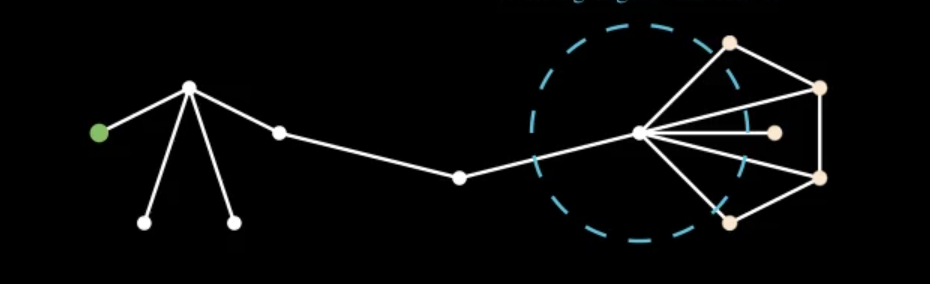
> AVOID: HIGH-COST D5 CUTS
Fig. 1 — Strategic visualization of a graph cluster.
- Targets high-density utility clusters (centrality)
- Navigates around “expensive” D5 edges
- Uses N=3 recurrence for reliable D3/D4 distillation